
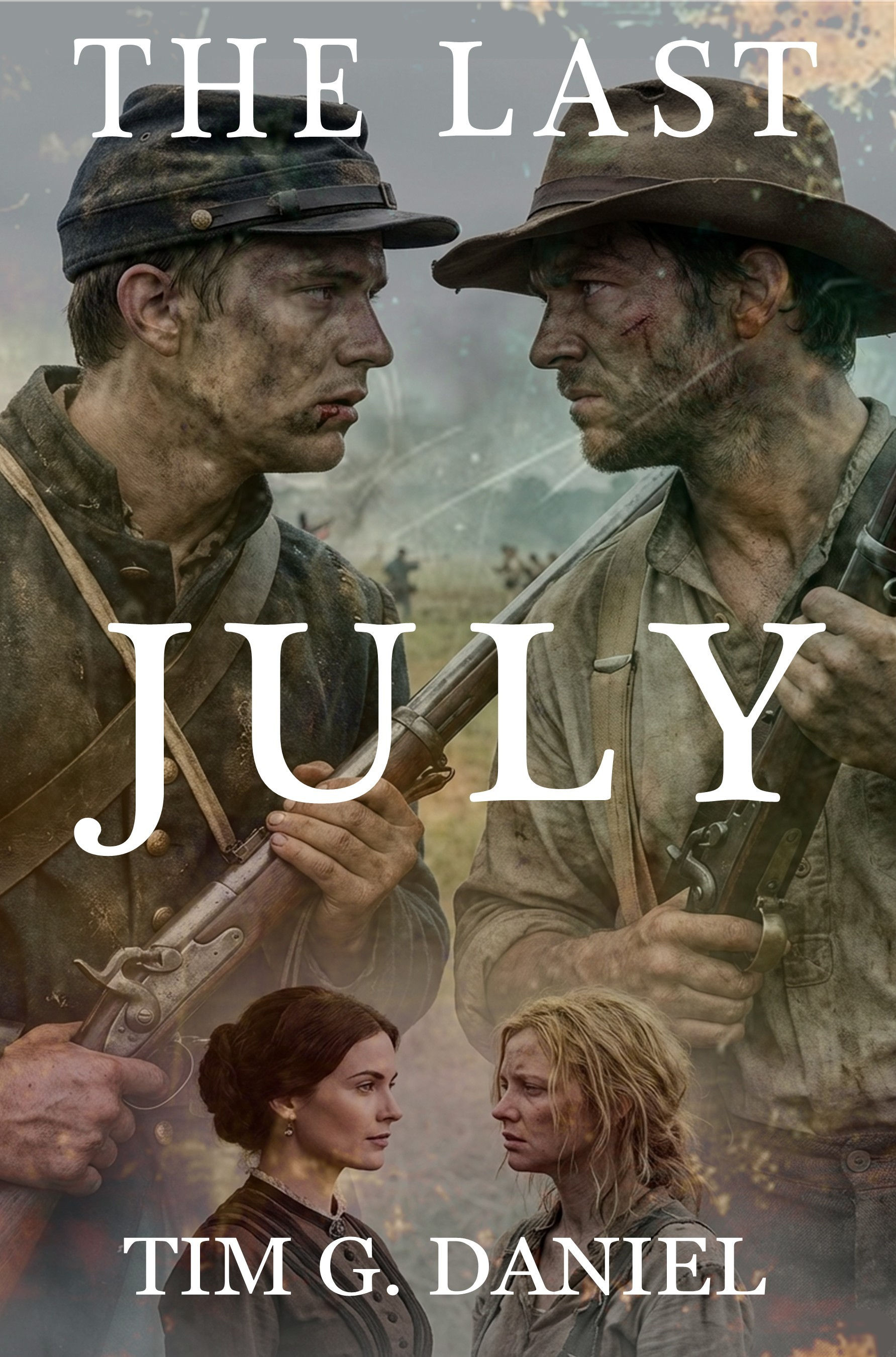
The Last July: Historical Fiction Novel
"The Last July is a historical fiction novels and one of the best I have ever read since since Widow of The South. So yeah, it's that good."
THE LAST JULY
A Novel by Tim G. Daniel
Genre: Historical Fiction / American Civil War / Dual-Family Saga
Format: Paperback / Hardcover / eBook
Length: ~86,000 words | 31 Chapters
Setting: Freeport, Maine & Alabama / The Rappahannock, Gettysburg, and the Civil War Eastern Theater, 1850–1884
Published by: Center for Historical Research Studies, Gettysburg, PA / History Nerd Tours, LLC
Overview: The Last July follows two families on opposite sides of the war and opposite ends of the American class ladder — the wealthy Wilkes family of Freeport, Maine, and the red-clay Tribble family of Alabama — whose lives collide when both send a son named Abraham to the same war. When Ellen Wilkes and Violet Tribble, a Northern industrialist's wife and a Southern widow, end up sharing one household and one grief, the novel follows their unlikely bond across two decades, through a devastating scene at a Portland train platform, and into a Reconstruction-era political reckoning that asks whether the country — and these two women — can actually be stitched back together.
Key Selling Points:
Dual-POV, dual-region structure — Maine mill money and Alabama red clay collide instead of running in parallel
Built from real preserved family letters, artifacts, and documents the author has held and researched directly
A signature gut-punch scene (the pine coffin vs. the paid-for Fisk metallic case) that crystallizes class, grief, and broken promises in a single image
Structured chapter-by-chapter through actual campaigns (the Rappahannock, Gettysburg 1863, Gettysburg 1864) with historian-level specificity
Closes on a genuinely novel payoff: the two dead soldiers' younger brothers run together on a real-feeling 1884 "National Union" presidential ticket, turning private grief into a public act of reconciliation
Opens with Proverbs 4:23 ("guard your heart") as a framing epigraph — signals the emotional, faith-adjacent register up front
